The Hidden Energy Leaks That Create Leadership Burnout
Burnout rarely begins with collapse.
It begins with pressure.
Not the pressure coming from deadlines, meetings, or leadership responsibilities alone. Those pressures are real, but they are not usually the first problem. Burnout often starts with the pressure leaders create inside themselves.
That distinction matters.
Leadership Under Pressure is not simply about managing workload. It is about managing the internal narratives shaping how leaders respond to that workload.
Inside the Inner Arena™, burnout is often an alignment issue before it becomes an exhaustion issue.
A leader can still perform while burning out.
They can lead meetings, answer emails, support teams, and deliver results while quietly carrying internal tension that nobody sees. Over time, those hidden pressures become energy leaks that slowly weaken executive presence, decision-making, and confidence.
The danger is not always visible.
The leak is.
Burnout Is Built Through Energy Leaks
Many leaders think burnout means they need more sleep or time away.
Recovery matters, but burnout often starts much earlier.
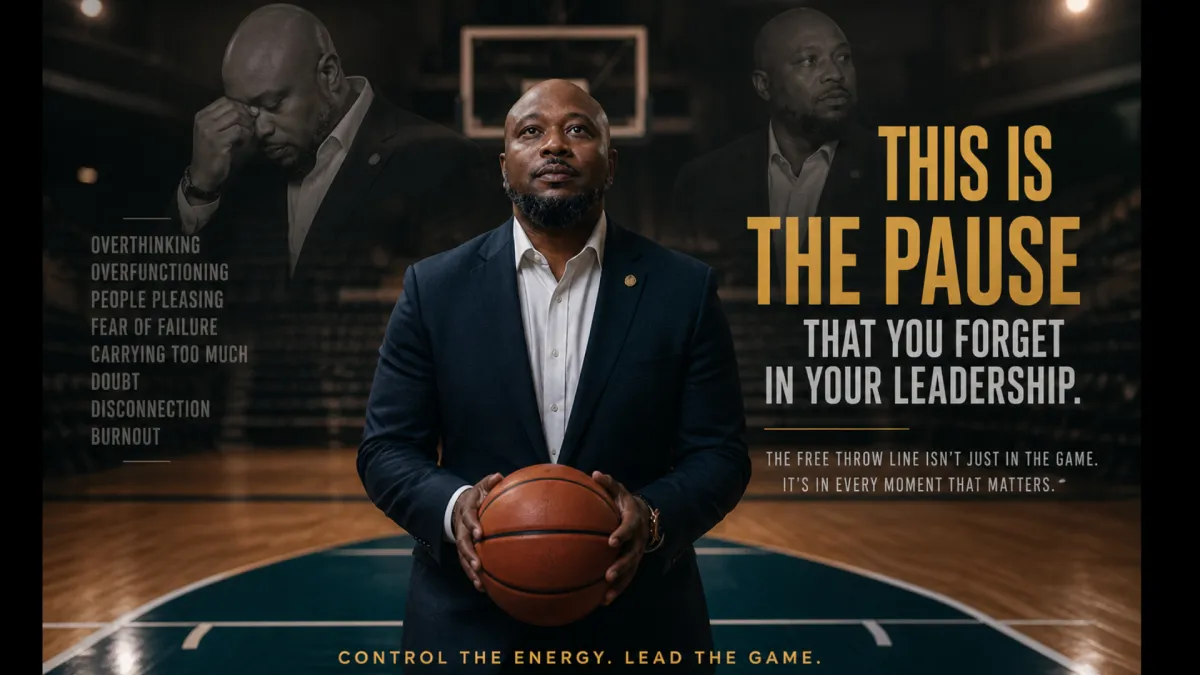
It begins through repeated energy leaks:
Overthinking decisions
Over-functioning to prove worth
Saying yes too often
Avoiding difficult conversations
Carrying unrealistic expectations
Ignoring physical stress signals
Letting the inner critic drive behavior
These leaks do not always feel dramatic.
They feel normal.
That is what makes them dangerous.
A new leader enters an organization excited and motivated. Then the internal pressure begins.
I need to prove myself.
I cannot ask for help.
I need everyone to know I deserve this role.
I cannot say no.
Those thoughts create pressure long before burnout becomes obvious.
What should feel exciting slowly becomes heavy.
This is where leadership starts drifting away from alignment.
The Pressure to Be Liked Creates Leadership Fatigue
One of the most overlooked leadership pressures is the expectation to be liked.
Leaders often hesitate to have difficult conversations because they fear damaging relationships or losing approval. They soften accountability, delay feedback, and avoid tension because they are protecting acceptance.
That creates a leadership problem.
Teams do not simply watch leadership.
They feel it.
They feel hesitation.
They feel uncertainty.
They feel when a leader is trying to protect approval rather than lead with clarity.
Executive presence is not only about communication style or confidence. It is energetic. People feel when a leader is grounded and when they are internally conflicted.
This is where the trust gap begins.
When leaders lead from approval-seeking instead of internal clarity, decisions become heavier, reactions become more emotional, and confidence becomes fragile.
Leadership gets harder because the leader is carrying more than responsibility.
They are carrying validation.
Your Body Often Knows First
Burnout does not always announce itself through exhaustion.
Sometimes it shows up through signals.
A headache.
Tension in the chest.
Mental fog.
Restlessness.
A nervous system that refuses to settle.
High-performing leaders often override these signals because they have learned to prize productivity over awareness.
They push through.
They normalize the discomfort.
They tell themselves they will slow down later.
That delay is costly.
The body often recognizes misalignment before the mind admits it.
Inside the S.W.A.G.® Framework, this is where Self-Awareness becomes leadership intelligence.
Self-Awareness is not theoretical.
It is the ability to notice:
What pressure am I carrying?
What story am I believing?
What signal am I ignoring?
What is draining my energy right now?
Without awareness, leaders react.
With awareness, leaders interrupt the pattern.
That interruption matters.
The Strategic Pause Strengthens Leadership
Many leaders believe they do not have time to pause.
That belief is often part of the burnout cycle.
When pressure rises, leaders become firefighters. They react to every issue, move faster, and convince themselves that constant activity equals leadership.
It does not.
Motion is not always leadership.
Sometimes it is survival.
The strategic pause creates something many overwhelmed leaders lack: perspective.
It allows leaders to ask:
What is actually happening?
What pressure am I creating myself?
Am I reacting from fear or alignment?
What decision reflects my values?
This is where Why-Power and Aligned Action begin working together.
When leaders reconnect to purpose and values, their decisions become steadier. They stop reacting solely from urgency, ego, or fear.
Pressure becomes easier to manage because leadership is no longer being driven by panic.
The Inner Arena™ matters here.
Leadership is won or lost internally before it is expressed externally.
When S.W.A.G.® Is Off, Leadership Gets Heavy
The burnout conversation is ultimately a leadership alignment conversation.
When S.W.A.G.® is off, leadership becomes heavier than it needs to be.
Self-Awareness drops, and leaders stop noticing the pattern.
Why-Power fades, and purpose gets replaced by proving.
Aligned Action weakens, and decisions become reactive.
Grit becomes distorted, turning resilience into unhealthy grinding.
That is not sustainable leadership.
Real grit is grounded.
It pushes forward without abandoning the leader in the process.
This is why Leadership Development must go beyond skill-building. Skills matter, but leadership behavior is shaped by the inner environment carrying those skills.
Internal narratives shape external leadership.
If the inner environment is driven by fear, perfectionism, approval, or self-doubt, leadership reflects it.
If it is grounded in awareness, values, and alignment, leadership reflects that too.
Burnout Is a Signal, Not a Character Flaw
Burnout is not proof that a leader is weak.
It is feedback.
A signal that pressure, expectations, or leadership patterns need attention.
The strongest leaders do not wait for collapse.
They notice the energy leaks.
They question the pressure.
They pause before reacting.
They reconnect to values and purpose.
That is where sustainable executive presence begins.
That is the work inside the Inner Arena™.
If leadership has started feeling heavier than it should, the next step is not pushing harder.
Start with the Burnout Mirror Assessment to identify the burnout archetype and energy leaks shaping your leadership.
Then go deeper through the Why You Feel Off as a Leader Workshop to rebuild alignment, strengthen self-awareness, and lead from the inside out.
Because burnout rarely begins with collapse.
It begins with what leaders ignore inside themselves.