When Leadership Culture Gets Stuck in the Middle
A senior executive sits in a leadership meeting listening to another presentation about organizational culture.
The language sounds right. Empowerment. Collaboration. Servant leadership. Psychological safety. Leaders are encouraged to trust their people, create space for new ideas, and develop employees who can make confident decisions without waiting for permission.
The executive believes in every word.
They model it with their direct reports. They remain composed during high-pressure moments. They ask questions before giving answers. They encourage people to challenge their thinking. They try to lead through service rather than authority.
Then an employee survey reveals a completely different organization.
Three to five layers below the executive team, employees describe a culture of fear, control, second-guessing, and approval chasing. Decisions are pushed upward. Managers dictate rather than develop. People protect themselves by remaining quiet. Employees have learned that taking initiative may be celebrated in the organizational values but punished by the person conducting their performance review.
The executive is stunned.
“That isn’t the culture we’re creating.”
Unfortunately, it may be the culture employees are experiencing.
That is one of the hardest realities senior executives face: the leadership culture intended at the top can be fundamentally different from the leadership culture lived throughout the organization.
The Culture You Model Is Not Automatically the Culture They Experience
Modeling the way matters. Employees watch senior leaders closely, especially when pressure rises.
When an executive pauses instead of reacting, remains curious instead of becoming defensive, and demonstrates composure when the stakes are high, that behavior establishes a visible leadership standard. It shows people that urgency does not have to become chaos and authority does not have to become control.
But modeling alone does not shift culture.
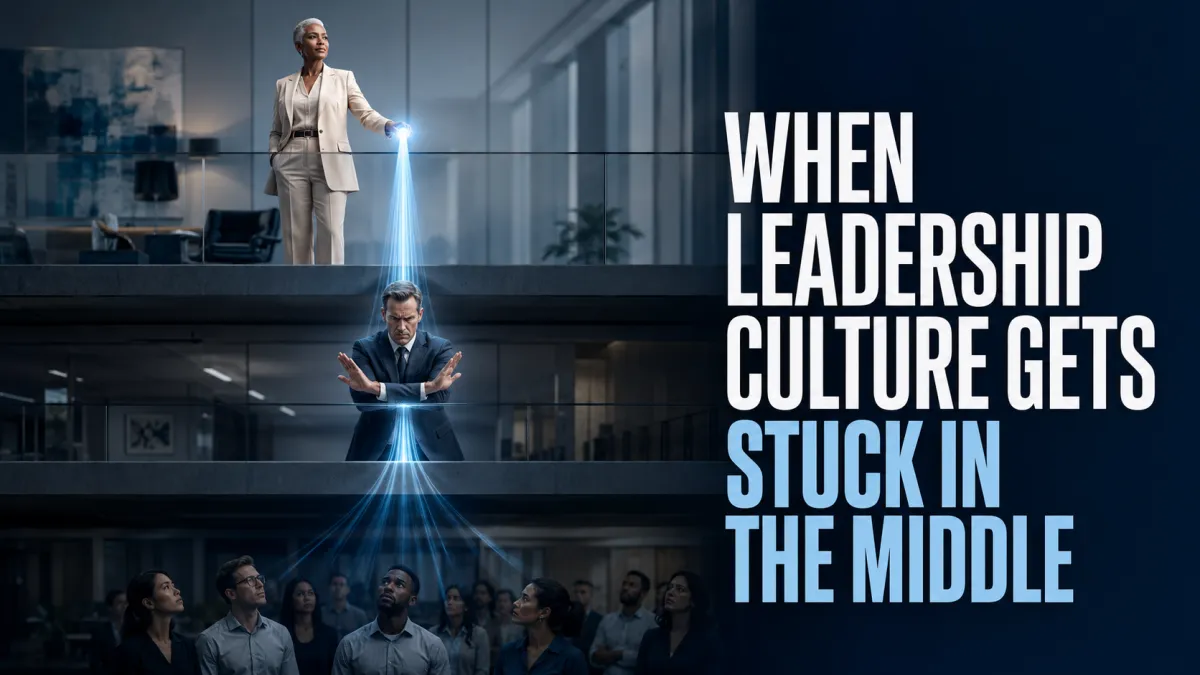
A senior executive can model servant leadership from the top floor while employees experience command-and-control leadership everywhere else. If the executive’s behavior does not travel through the organization’s management layers, it remains a personal leadership style—not an organizational culture.
Culture is not defined by the behavior demonstrated during an executive retreat. It is defined by what happens when a frontline employee questions a decision, makes a mistake, asks for help, or proposes a different way forward.
What happens in that moment?
Are they coached or corrected?
Are they invited into the decision or told to stay in their lane?
Does their manager become curious or threatened?
Does initiative build credibility or create personal risk?
Those moments tell employees what the culture actually rewards.
Middle Management Is the Cultural Transmission System
Senior leaders set direction, but managers translate that direction into daily experience.
Every organizational value must pass through them. Trust, accountability, transparency, innovation, inclusion, and psychological safety all become real—or disappear—through the decisions managers make every day.
That makes middle management the cultural transmission system of an organization.
Some managers amplify the leadership standard. Others distort it. A few block it completely.
This does not mean middle managers are automatically the villains of the story. Many are caught between competing expectations. Senior leadership tells them to empower employees, but still holds them accountable for aggressive timelines, flawless execution, limited resources, and outcomes they cannot completely control.
When the pressure climbs, empowerment can quickly become supervision. Supervision becomes interference. Interference becomes command and control.
That transition often happens without the manager recognizing it.
High-performing leaders are particularly vulnerable to this blind spot. Their success was frequently built on personal discipline, high standards, fast execution, and the ability to produce under pressure. Because that formula worked for them, they naturally expect others to respond the same way.
The missing component is often empathy.
They understand the importance of the bottom line, but they may not recognize how their pursuit of execution affects the people responsible for delivering it. They believe they are raising the standard. Their employees experience constant pressure, limited autonomy, and the message that leadership does not trust them to think.
That is how an organization can publicly promote empowerment while privately producing dependency.
The Ted Lasso Lesson Is Not Positivity
Ted Lasso offers a useful picture of how cultural influence actually moves.
Ted does not enter AFC Richmond with traditional credibility. He is an American football coach taking responsibility for a British soccer club—a sport he barely understands. He cannot rely on expertise, positional familiarity, or an impressive history within the organization.
He has to build influence through relationships.
Ted works upward with team owner Rebecca Welton. He works downward with the players. He identifies informal leaders such as Roy Kent, whose credibility inside the locker room gives him influence that no organizational chart can manufacture.
Ted understands something many executives miss: culture does not move simply because the person at the top believes in it. It moves through people whom others already trust.
His morning “Biscuits with the Boss” ritual with Rebecca illustrates this. The biscuits are not important because they are pastries. They are important because they represent consistency. Ted keeps showing up. He creates a dependable point of connection. Each interaction becomes a small deposit of trust.
Eventually, the ritual makes room for a relationship.
Ted also does not attempt to personally control every relationship on the team. He earns Roy’s trust because Roy can reach players in ways Ted cannot. Roy becomes a cultural bridge between the coach’s leadership philosophy and the locker room’s lived reality.
That is the executive challenge.
Who are your cultural bridges?
Who can translate your leadership standard across the organization? Who has credibility with the managers and employees you rarely encounter? Who is reinforcing the culture—and who is quietly bottlenecking it?
If the culture depends entirely on employees having direct access to the senior executive, it is not scalable.
The Pause Is a Leadership Intervention
One of the first behaviors lost under pressure is the pause.
Leaders convince themselves they cannot afford to slow down because slowing down means losing momentum, surrendering an advantage, or appearing uncertain. They move faster, tighten control, and make more decisions personally.
What feels like strength can become an Energy Leak™.
The leader’s mental energy becomes consumed by decisions others should be making. Emotional energy drains through frustration and distrust. Behavioral energy gets trapped in over-functioning, repeated checking, and unnecessary approvals. Strategic Capacity disappears because the leader is staring at every play instead of seeing the whole field.
The pause interrupts that pattern.
In sports, halftime is not an admission that the team has stopped competing. It is a structured opportunity to examine what is happening, regulate emotion, adjust strategy, and return to the field with greater clarity.
Executives need the same Leadership Locker Room™ discipline.
The pause allows a leader to ask:
What behavior is pressure pulling out of me?
Am I strengthening Decision Trust or teaching people to wait for me?
Is my urgency helping the organization execute, or causing others to stop thinking?
What leadership behaviors are being rewarded several layers below me?
Where is our stated culture breaking down in practice?
That is S.W.A.G.® in motion: Self-Awareness to recognize the pattern, Why-Power to reconnect with the leadership culture being built, Aligned Action to address the bottleneck, and Grit to reinforce the standard when pressure makes command and control feel easier.
Culture Must Be Operationalized
Executives cannot merely announce the culture they want. They must make it observable, coachable, and accountable.
If servant leadership is the standard, define the behaviors that demonstrate it. If empowerment matters, clarify which decisions employees should make without escalating them. If leaders are expected to create psychological safety, evaluate how they respond to mistakes, disagreement, and bad news.
Research supports the need to move beyond slogans. MIT Sloan describes distributed leadership as a move away from command and control toward collaborative, autonomous practices carried through networks of formal and informal leaders. The senior leader’s responsibility becomes creating the conditions in which people throughout the organization have permission to contribute their expertise—not remaining the person with every answer. MIT Sloan
Psychological safety also requires more than leaders being pleasant. It involves the ability to offer candid feedback, acknowledge mistakes, raise concerns, and learn without fear of punishment. Harvard Business Review
That means executives must examine the full leadership system:
Are managers being selected only because they were strong individual performers?
Are promotions rewarding execution without evaluating empathy?
Are leaders told to empower people but punished when their teams make mistakes?
Are coaching behaviors part of performance expectations?
Do employees have a safe way to reveal where the leadership standard is breaking down?
Culture changes when leadership behavior is reinforced through hiring, promotion, development, evaluation, recognition, and accountability.
Otherwise, the organization is asking managers to change while continuing to reward the behaviors that created the problem.
Your Executive Presence Has to Travel Without You
Executive Presence is often treated as the influence a leader has when they enter a room.
The larger test is what happens when they are nowhere near the room.
Do managers carry the leader’s composure into difficult conversations? Do they create space for others to think? Do they coach instead of immediately taking control? Do employees still experience trust when the executive is five layers away?
A culture shift begins internally, but it cannot remain there.
The senior executive must model the standard, identify the cultural bridges, develop managers who can transmit it, and confront the behaviors that contradict it. That may require uncomfortable conversations with high-performing leaders whose results are strong but whose leadership is weakening the organization around them.
That is where conviction matters.
You cannot claim to build a culture of trust while protecting leaders who repeatedly destroy it.
The goal is not to eliminate standards, urgency, or accountability. Servant leadership is not passive leadership. The goal is to ensure that high expectations do not strip people of their ability to think, contribute, and lead.
Culture is not what the senior team intends.
Culture is what the organization repeatedly experiences.
If those two realities are different, the work is not finished.
If the culture you are modeling is not reaching the people you lead, the challenge may not be your vision. It may be the leadership patterns interrupting its movement.
Executive Coaching with Coach Mo helps senior leaders examine those hidden pressure patterns, strengthen Decision Trust, and build a leadership standard that travels through the organization—not one that disappears outside the executive suite.