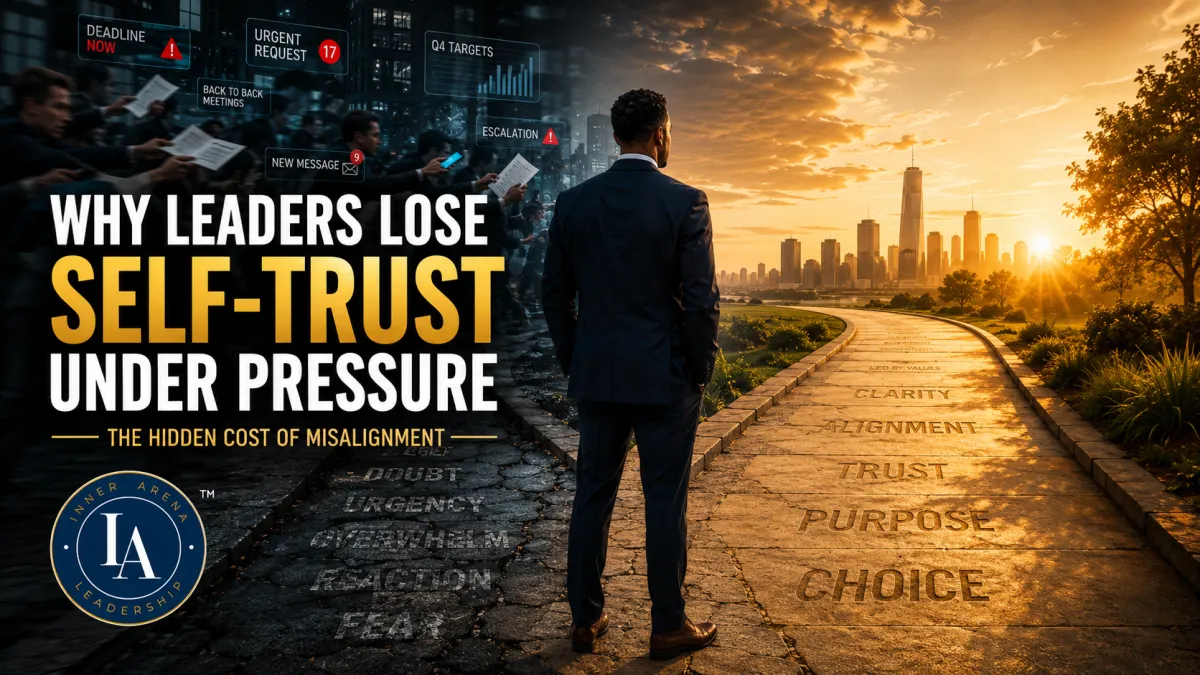
Why Leaders Lose Self-Trust Under Pressure
High-performing leaders rarely struggle because of a lack of capability.
They struggle because they gradually lose trust in themselves.
From the outside, they appear successful. They hit goals. They solve problems. They carry responsibility. They become the person everyone depends on.
Internally, however, something different is happening.
Decision-making becomes heavier.
Confidence becomes conditional.
Clarity begins to disappear.
The leader who once trusted their instincts now second-guesses decisions they would have made effortlessly a few years earlier.
This is one of the least discussed realities in Leadership Development.
The problem is not competence.
The problem is disconnection.
Leadership is won or lost inside the Inner Arena™ first.
When leaders become disconnected from themselves, self-trust begins to erode.
And when self-trust erodes, influence, composure, and decision quality often follow.
The challenge is recognizing it before the damage becomes visible.
Grounded in the leadership insights shared throughout this conversation, one consistent theme emerged: leaders lead most effectively when they remain aligned with their values, aware of their internal state, and intentional about how they respond under pressure.
The Hidden Cost of High Achievement
Many leaders spend years chasing what they believe success should look like.
Promotions.
Recognition.
Authority.
Responsibility.
External achievement often creates the appearance of progress while quietly pulling leaders further away from themselves.
Over time, leaders become conditioned to prioritize performance over alignment.
The result is predictable.
They become exceptionally skilled at producing results while becoming increasingly disconnected from what actually matters to them.
This disconnect rarely shows up overnight.
It accumulates through hundreds of small decisions.
Ignoring exhaustion.
Overriding instincts.
Sacrificing values for urgency.
Prioritizing expectations over purpose.
Eventually, leaders find themselves wondering why they feel overwhelmed despite being successful.
The answer is often simple.
They have drifted away from themselves.
Why Self-Trust Disappears
Most leaders assume self-trust is a mindset issue.
It is not.
Self-trust is often an alignment issue.
When leaders consistently act in ways that conflict with their values, internal tension develops.
That tension creates doubt.
Doubt creates hesitation.
Hesitation creates indecision.
The internal narrative becomes louder than the leader's instincts.
This is where many leaders become trapped.
Pressure increases.
The inner critic becomes more active.
Assumptions replace clarity.
Fear replaces confidence.
Leaders begin operating from reaction rather than intention.
The challenge is not that they lack answers.
The challenge is that they can no longer hear themselves clearly.
The Leadership Skill Nobody Taught You
Most leaders are taught how to manage projects.
Few are taught how to manage themselves.
That gap becomes obvious during moments of pressure.
When uncertainty rises, many leaders default to autopilot.
They react.
They defend.
They rush.
They over-function.
Not because they want to.
Because they have never developed a leadership operating system for regulating themselves under pressure.
This is where the Inner Arena™ becomes critical.
Pressure is managed from the inside out.
The quality of leadership is heavily influenced by the quality of the leader's internal environment.
Without awareness, leaders become prisoners of their automatic responses.
With awareness, leaders regain choice.
And choice changes everything.
The Pause That Changes Leadership
One of the most overlooked leadership skills is the ability to pause.
Not stop.
Pause.
The pause creates space between stimulus and response.
It creates space between emotion and action.
It creates space between pressure and decision.
Most importantly, it creates space for values to re-enter the conversation.
During pressure-filled moments, leaders often ask:
What should I do?
How do I fix this?
How do I make this go away?
A better question is:
Who do I want to be in this moment?
That question shifts attention from reaction to intention.
It reconnects leaders to what matters most.
It restores self-trust because actions become aligned with values rather than emotions.
As discussed in the conversation, meaningful leadership decisions often emerge through this pause where reflection, awareness, and values reconnect.
Rebuilding Self-Trust Through the S.W.A.G.® Framework
The path back to self-trust aligns naturally with the S.W.A.G.® Framework.
Self-Awareness
Leaders must first recognize when they are off.
Most leaders continue pushing forward without realizing they are operating from frustration, exhaustion, fear, or uncertainty.
Awareness creates the opportunity to interrupt autopilot.
Why-Power
Values create meaning.
Meaning creates direction.
When leaders reconnect to why something matters, they regain access to purpose instead of becoming consumed by pressure.
Aligned Action
Self-trust is built through evidence.
Every action aligned with values becomes a vote for the leader you are becoming.
Small consistent actions create powerful internal credibility.
Grit
Leadership under pressure requires discipline.
Not the discipline to push harder.
The discipline to stay aligned when pressure tempts you to abandon yourself.
That is where sustainable leadership lives.
Leadership Effectiveness Begins With Restoration
Many leaders attempt to solve psychological problems that are actually capacity problems.
Lack of sleep.
Poor recovery.
Emotional overload.
Chronic stress.
Mental exhaustion.
These factors dramatically impact judgment, emotional regulation, and self-trust.
One of the strongest insights from the conversation was the importance of evaluating the leader's personal ecosystem before addressing deeper leadership challenges. Physical and emotional capacity create the foundation for everything else.
You cannot consistently make high-quality decisions from an empty battery.
You cannot lead others effectively while ignoring yourself indefinitely.
Leadership capacity is not a luxury.
It is a requirement.
Conclusion
The leaders who thrive under pressure are not necessarily the smartest leaders.
They are the most connected leaders.
Connected to their values.
Connected to their purpose.
Connected to their awareness.
Connected to their ability to pause before reacting.
Leadership Development is not simply about acquiring new skills.
It is about strengthening the relationship a leader has with themselves.
Because when self-trust returns, clarity follows.
When clarity returns, decisions improve.
And when decisions improve, leadership influence expands.
Leadership starts internally.
The outer results are simply a reflection of what is happening inside the Inner Arena™ first.
Feeling Off as a Leader?
If you're carrying pressure, second-guessing decisions, or feeling disconnected from your leadership, start with the Why You Feel Off as a Leader Workshop.
For a deeper look at how pressure may be impacting your leadership effectiveness, take the Burnout Mirror Assessment and identify the hidden patterns affecting your performance before they become burnout.