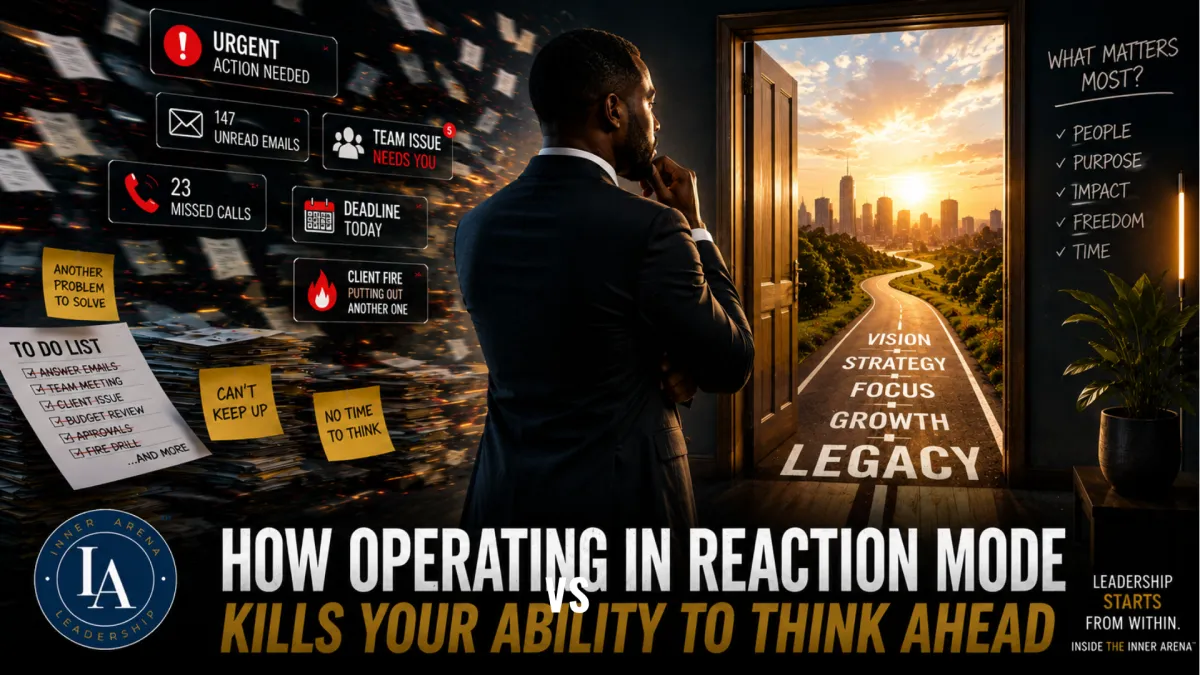
Why Leaders Lose Their Strategic Capacity Under Pressure
Most leaders do not lose their strategic capacity overnight.
They lose it one interruption at a time.
One urgent email.
One unexpected problem.
One fire drill.
One more request that feels impossible to ignore.
Over time, leadership becomes less about creating the future and more about surviving the day.
The result is a dangerous leadership trap: reaction mode.
Many high performers were rewarded for reacting quickly. Their ability to solve problems, execute fast, and push through pressure helped them earn promotions and leadership opportunities.
Then leadership changed.
The skills that helped them become successful contributors became the same habits limiting their ability to think strategically.
Leadership under pressure often reveals this shift.
The leader is busy.
The calendar is full.
The inbox never stops.
Yet despite constant activity, there is little confidence that meaningful progress is being made.
The problem is not effort.
The problem is that reaction has replaced intention.
This challenge surfaced repeatedly throughout the conversation in Let’s Think About It Podcast Episode 95, where the discussion explored how leaders become trapped in constant responsiveness, creating nervous systems conditioned for survival instead of strategy.
The Hidden Cost of Constant Reaction
Most leaders believe their stress comes from the volume of work.
In reality, much of the stress comes from how they are engaging with the work.
When every day is spent responding to demands, leaders begin operating from urgency instead of purpose.
They stop asking:
Where are we going?
What matters most?
What are we building?
What should we stop doing?
Instead, they ask:
What's next?
What's broken?
Who needs me now?
Those questions create very different outcomes.
The Inner Arena™ teaches that leadership starts internally.
External pressure is inevitable.
Internal pressure is optional.
When leaders become trapped in reaction mode, they surrender control of their internal environment. They allow circumstances to dictate their thinking instead of intentionally directing their attention.
That is where strategic capacity begins to erode.
Why High Performers Struggle Most
Ironically, high performers are often the most vulnerable.
They built their careers by being dependable.
They solved problems.
They worked harder.
They carried more responsibility.
They became the person everyone trusted.
Then leadership expanded.
Suddenly, success was no longer about doing the work.
Success became helping others do the work.
This transition creates enormous internal friction.
Many leaders continue carrying the mindset of the star player when the role now requires the mindset of the coach. That shift requires leaders to stop believing they must personally have every answer and start developing the answers in others.
Without that shift, leaders become bottlenecks.
Every decision flows through them.
Every problem lands on their desk.
Every challenge becomes theirs to solve.
The nervous system never gets a break.
Strategic Thinking Requires Space
One of the most overlooked leadership skills is creating thinking time.
Not more productivity.
Not more efficiency.
Thinking.
Many leaders feel guilty slowing down because slowing down appears unproductive.
But strategic thinking is leverage.
Without it, leaders continue solving the same problems repeatedly.
The discussion in Episode 95 highlighted a simple truth: leaders become overwhelmed when they spend their entire day reacting to other people's fires instead of creating time to focus on what being proactive actually looks like.
This is where Self-Awareness, the first dimension of the S.W.A.G.® Framework, becomes critical.
Leaders must recognize when they have become trapped in activity rather than progress.
Awareness creates choice.
Without awareness, reaction becomes automatic.
The Connection Between Values and Strategic Capacity
Many leaders assume burnout comes from doing too much.
Often, burnout comes from doing too much that is disconnected from what matters most.
When leaders lose connection with their values, everything begins to feel heavier.
Decision-making becomes harder.
Motivation decreases.
Frustration increases.
The conversation emphasized that when leaders experience overwhelm, disappointment, or distrust, there is often a deeper question worth exploring:
What value is currently out of alignment?
This is where Why-Power enters the conversation.
Purpose creates direction.
Values create alignment.
Together they help leaders determine which opportunities deserve attention and which distractions should be ignored.
Without those filters, everything feels urgent.
Building a Strategic Leadership Rhythm
Strategic leaders do not rely on motivation.
They rely on rhythm.
One of the strongest themes from Episode 95 was the importance of intentionally creating operating rhythms that force leaders to step back, reassess priorities, and reconnect with the larger vision.
Strategic capacity grows when leaders consistently ask:
What is the vision?
Clarity reduces noise.
What are we trying to achieve?
Purpose drives focus.
Who owns what?
Accountability eliminates confusion.
What matters most in the next 90 days?
Priorities create momentum.
These questions move leaders from reaction to intentional action.
This aligns directly with the Aligned Action dimension of S.W.A.G.®.
Activity alone is not leadership.
Aligned action is.
Leadership Is Won Inside the Inner Arena™
The greatest leadership battles rarely happen in conference rooms.
They happen internally.
The fear of not knowing.
The pressure to have answers.
The belief that slowing down is irresponsible.
The assumption that leadership means carrying everything alone.
Those narratives quietly shape leadership behavior.
The leaders who sustain performance over the long term learn a different lesson.
They pause.
They reflect.
They reconnect with purpose.
They align with values.
They create space to think.
And they develop the courage to lead proactively instead of reactively.
That work happens inside the Inner Arena™ first.
Conclusion
Reaction mode feels productive.
It feels responsible.
It even feels necessary.
But over time, it steals the very thing leaders need most: the ability to think ahead.
Strategic capacity is not built by doing more.
It is built by creating enough space to see clearly.
The leaders who thrive under pressure are not necessarily the fastest.
They are the most intentional.
They understand that leadership development begins internally.
They know their values.
They reconnect with their purpose.
They trust the process.
And they refuse to let urgency become their strategy.
Discover Your Burnout Pattern
If constant pressure has you operating in reaction mode, start by identifying the hidden patterns driving your leadership behavior.
Take the Burnout Mirror Assessment and uncover the burnout archetype influencing your decision-making, focus, and leadership effectiveness.
Feeling Off as a Leader?
Join the Why You Feel Off as a Leader Workshop7 to reconnect with your values, purpose, and leadership foundation before burnout and overwhelm take a greater toll.